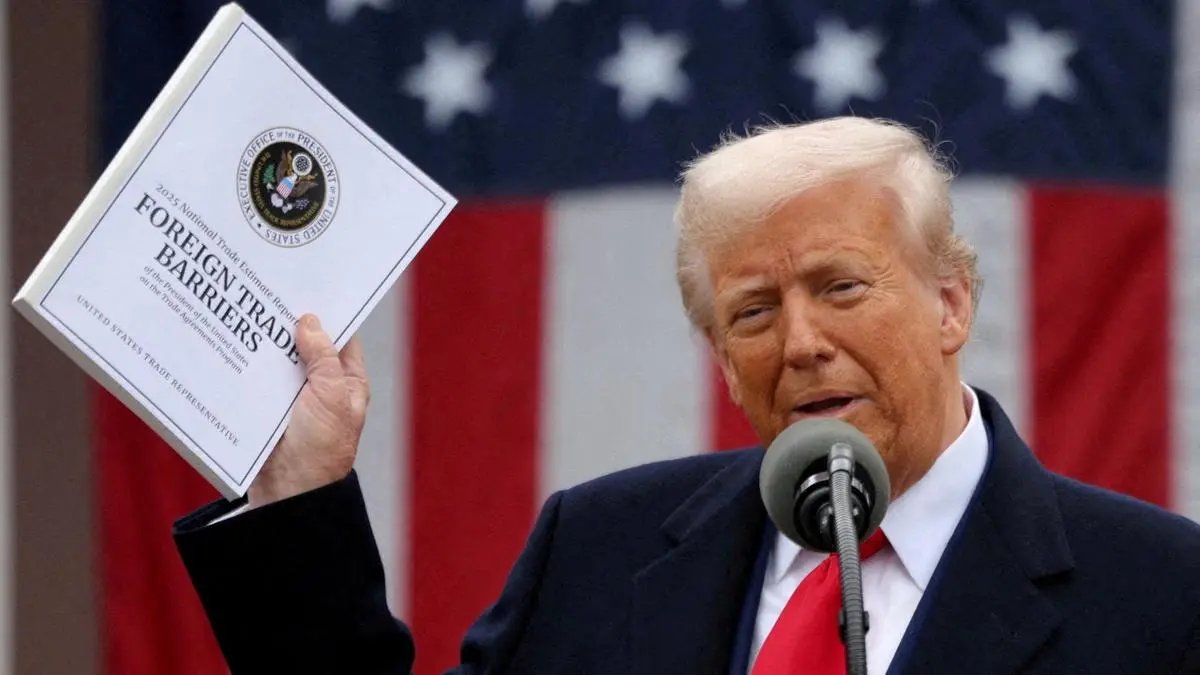

FILE PHOTO: US President Donald Trump holds a “Foreign Trade Barriers” document as he delivers remarks on tariffs in the Rose Garden at the White House in Washington, DC, US, April 2, 2025.
| Photo Credit:
Carlos Barria
It is a mix of relief and confusion for Indian exporters following the US Supreme Court’s strike-down of US President Donald Trump’s sweeping emergency tariffs. While the decision signals a victory for trade, industry players are staying cautious until the full regulatory fallout is clear.
Some trade experts say that India had been too hasty in concluding an interim trade deal with the US and lost its bargaining power. But, as the agreement had not been legally signed, some leverage can still be used to protect the country’s sensitivities better, they say.
“I think this will definitely have an impact on India-US BTA (bilateral trade agreement). We need to understand more clearly since it’s a developing story,” said Pankaj Chadha from EEPC.
Sanjay Jain, a textiles exporter to the US, who had been meticulously mapping the tariffs faced by competing countries vis-a-vis India, is overwhelmed by the development. “This is chaos in short. Let us see how it plays out,” Jain said.
“Major development”
Chennai-based leather products exporter Israr Ahmed noted that it was a “major development” and he was optimistic.
The US SC decision effectively renders recent trade deals initiated or concluded by the US with the UK, Japan, the EU, Malaysia, Indonesia, Vietnam and India one-sided and useless, said Ajay Srivastava, founder, GTRI.
“Partner countries may now find reasons to dump these deals. Trump could attempt to reimpose similar tariffs under Section 301 or Section 232, but those statutes require new investigations and public justification, delaying action and inviting further legal challenges. Also, such measures cannot serve as a universal enforcement tool,” said Srivastava.
However, it may be difficult for India to get out of the interim deal agreed to with the US, said Biswajit Dhar, independent trade expert.
“The whole thing goes topsy turvy now. India should have waited and looked at its options.
We haven’t signed the deal. We can still back track. But we have made a political commitment with both leaders endorsing it,” Dhar said.
India can still leverage what has happened, if it wanted to, Dhar added. “We can certainly try to protect our sensitivities, especially in agriculture, better,” he said.
Published on February 20, 2026