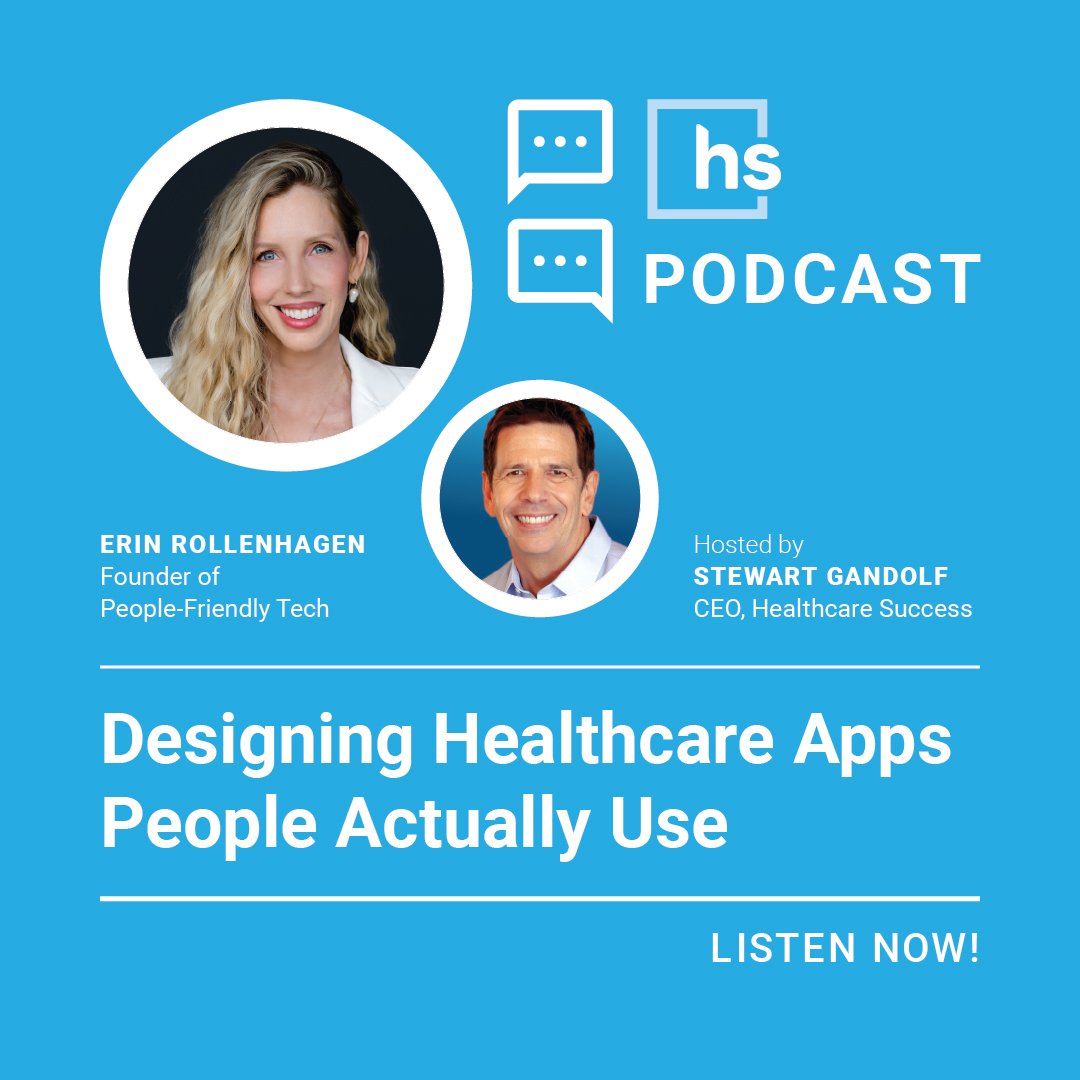
When does a healthcare app actually improve patient experience—and when is it a costly distraction?
In this week’s podcast, Stewart Gandolf sits down with Erin Rollenhagen, Founder of People-Friendly Tech, to explore how healthcare organizations can decide whether to build an app, what it should do, and how to design it so patients actually want to use it—especially in high-stress healthcare moments.
Drawing from years of experience designing software in healthcare and other highly regulated industries, Erin shares why user experience is not a “nice-to-have,” how poorly designed apps quietly damage brand trust, and what healthcare leaders need to know before committing time, money, and resources to app development.
This episode helps healthcare leaders move past “we should have an app” thinking and toward smarter digital decision-making.
You’ll learn how to:
• Decide when an app is strategically justified
Understand the specific use cases—like billing, records access, telehealth, and scheduling—where apps consistently deliver value.
• Design apps around emotion, not feature lists
Learn why the feeling a user has while using an app matters more than functionality alone, especially in stressful healthcare contexts.
• Increase adoption and sustained use
Discover what motivates patients to download an app, continue using it, and build habits that deepen engagement over time.
If you’re a healthcare leader considering an app—or wondering why an existing one isn’t getting traction—this episode is a must-listen.
Note: The following AI-generated transcript is provided as an additional resource for those who prefer not to listen to the podcast recording. It has been lightly edited and reviewed for readability and accuracy.
Stewart Gandolf (Healthcare Success): Yeah, for sure. Okay. All right. Welcome to the Healthcare Success Podcast. Today, we’re going to be interviewing Erin Rollenhagen. She is the founder of People-Friendly Tech. Welcome, Erin.
Erin Rollenhagen (People-Friendly Tech): Thank you very much. I’m glad to be here, Stewart.
Stewart Gandolf (Healthcare Success): Cool. So today, we’re going to talk about a topic that comes up frequently, and I’m really excited to get your insights about this particular topic, the whole world of apps.
And, you know, apps have been around a long time now, right? So it’s been quite a progression over the years. And I remember back in the early days, everybody said, let’s get an app. And then I think they probably still do, Erin.
So sometimes it makes a lot of sense. It’s on target strategically. Sometimes it doesn’t make sense at all. But anyway, I guess, why don’t we start with just a quick background, you know, one-minute overview of you and your company, just so our listeners and readers are founded and what this is all about.
Erin Rollenhagen (People-Friendly Tech): Yeah, absolutely. So I am the founder and CEO of People-Friendly Tech. We help visionaries and healthcare, insurance, and other highly regulated industries turn bold visions into apps and software that people actually love to use, even in stressful moments.
And that really came about from working with a client at the federal government on an EHR and witnessing how the EHR could either be a tool that doctors looked forward to using or a tool that they dreaded using, and the difference could make a big impact on their care of patients.
Stewart Gandolf (Healthcare Success): That’s really intriguing. And I think the idea of user experience is so important because we forget, right? Is it just pretty or is it actually something you can use?
So we’ll probably talk about that, I’m guessing. So let’s start at the very beginning. Why should healthcare organizations even create an app?
What would be a good use case where you think an app would make sense? And then, you know, on the flip side of that, when is an app a bad idea?
Erin Rollenhagen (People-Friendly Tech): There are a couple of situations in which making an app can make a lot of sense for a healthcare organization.
One is, of course, if you’ve identified a specific use case that your patients would really love to use an app to work through.
Apps have great user satisfaction ratings for working through things like billing and retrieving records, those sorts of tasks that people would really prefer not to have to call someone to execute that task.
Another reason that can be really successful is if there’s a general sense of wanting to serve those patients better and use a technology tool to deepen their relationship with those patients.
That can be really successful too, and then we work backwards to find what are the specific problems we can solve that will affect that.
The worst reason to create an app is because someone went to a conference and got some FOMO because everyone else was talking about apps, and those projects tend to be a little less successful.
Stewart Gandolf (Healthcare Success): So we have to come back about app usage later, because that can be a real thing, right? Building an app that nobody needs, nobody wants, and we wonder why nobody is engaging with it. So I can see that.
So let’s talk about, you’ve obviously been working in healthcare as one of your primary niches. We’re thinking about healthcare organizations, Erin, what kinds of healthcare organizations are you used to working with most?
Is it all across the board? Is it pharma or hospital systems or practices? Or what kinds of businesses do you work with usually?
Erin Rollenhagen (People-Friendly Tech): We’ve worked with a variety of businesses, but some of the most successful have been around deploying telehealth solutions.
I live in Iowa, which has a large rural population. And so telehealth solutions for things like psychiatry, certain emergency services, mental health services, can be a really successful way of providing services to those rural areas that would otherwise be really difficult to come by.
Stewart Gandolf (Healthcare Success): That makes sense. So there’s a real, again, a real use case. So what kind of ROI would, you know, is there ROI with building an app or is it just an expensive, long, hard endeavor?
Erin Rollenhagen (People-Friendly Tech): Well, you certainly, you hope there is ROI and we try to guide our clients towards situations where there is ROI or, you know, honestly tell them that we don’t see where the ROI would come from.
But when you find that ROI, it’s usually existing in one of two categories. You’re either gaining some sort of efficiency, maybe that’s, you know, we talked a few moments ago about the fact that people don’t always want to call someone to execute simple tasks, to pay a bill, to retrieve some records, to check on the status of an appointment.
There is actually really high app satisfaction with being able to do that within an app. So those sorts of efficiencies can relieve burden on call centers and customer service personnel.
The other type of ROI that’s a little harder to measure but can be a lot more powerful is if you can use that app to actually change the way that person is interacting with your institution, with your facility, and maybe get them to see the organization in a different light.
So is there a way that you can serve them better? Is there a way that you can prove that you’re really on their side and make that relationship deeper?
Stewart Gandolf (Healthcare Success): So that leads us to our next question, which is, you know, you’re really alluding to the relationship they have with the organization or another way of putting that is the brand.
So how can an app shape for good and for ill the customers’ or the patient’s experience with the brand?
Erin Rollenhagen (People-Friendly Tech): Everyone’s seen examples of the unfortunate shaping of the relationship, right, where you might have had a negative technology experience and you think, I don’t ever want to deal with this organization again. This has been so frustrating.
The reverse can be true, too. It just takes consistency. And so an example may be that a user could feel disadvantaged or might feel a lack of confidence around their knowledge of the healthcare system.
And when that happens, that user can also feel negatively toward the brands associated with their healthcare. Through no fault of those brands, it’s just the user feeling a lack of confidence.
If you can use that app to help them feel more on top of what they’re doing with their own healthcare, it removes that disparity and it lets them feel more positively toward the brand, especially if the brand is the one that provided them the tool that made them feel more confident.
Stewart Gandolf (Healthcare Success): So that makes a lot of sense. And the idea of… You know, we talk a lot when we’re speaking or working with clients that every little facet of the user experience makes the brand, right?
So I always say it’s like, what’s it like to set an appointment? What’s it like to wait in the waiting room?
You know, what things do you not expect to see? Like, for example, one my favorite stories was I walked up to a new hospital and there was a dead rat going through the death throes in the parking lot.
To me, that’s always part of the brand. Like, that’s probably 15 years ago and I still remember that. And I asked the security guard to throw it out.
He’s like, “not my job.” So the rat just stayed out there dying. So that’s, you know, those things all impact a brand.
And so if the app is not what people were hoping or difficult to use, they probably have some not family-friendly words while they’re using it trying to get through.
Because it’s frustrating, right? I’m sure our listeners can relate to a frustrating app experience. We’ve all had those. So if there’s somebody in the business considering an app who’s got the vision for it, and it’s the first time, you know, somebody in the marketing department or somebody in the CEO or whomever, you know, give us a hint about, like, what do need to know about this?
And you mentioned before when we spoke earlier, there’s about three things you should really know. So tell us some of the things you should know before you get into this.
Erin Rollenhagen (People-Friendly Tech): The first thing that they should absolutely know, and I’m curious if you would agree with this from a branding standpoint, but is that the feeling is the most important thing.
It’s not the feature list. It’s not the bullet points you’re going to put in the email announcement about the app. It’s the feeling. How does the user feel when they use that app?
Stewart Gandolf (Healthcare Success): I would agree. And I would just say the other option, the way to say this is part of the user experience, right?
And what’s the emotional outcome from dealing with the app? So for sure, I’d love to hear more.
Erin Rollenhagen (People-Friendly Tech): Yeah, absolutely. So once we have established the feeling, you want to think about what is the archetype for your app?
And there’s really three archetypes that we look at. There’s the dragon slayer archetype, which is there’s something the user is afraid of or concerned about, and we’re going to help them solve that problem right away. That’s usually a flash in the pan, a quick moment. We’ve got to get in, get out, help them solve the problem.
The next is a journey guide. That’s sort of the opposite, where someone is on a journey and your organization is guiding them toward a better place. Maybe it’s better health generally. That’s not fear-based or negative emotion-based. It’s positive emotion-based. So it has a lot more longevity to it.
And then the third type is a simplifier. And that’s a combination of the two. So it might start out as a dragon slayer type of archetype and then move toward a journey guide as you establish that relationship with that user.
Stewart Gandolf (Healthcare Success): Great. So getting the purpose, how much time do you spend when you’re working with a client or prospective client to really think through what is this going to actually be?
Is that, you know, is the planning part of it the most essential. I can imagine you’re not going to start without knowing where you’re going, for example.
Erin Rollenhagen (People-Friendly Tech): Exactly. And it’s really critical because the developers cannot code their way out of improper thinking or a badly designed product. So it’s our responsibility to do all of that thinking up front, make sure that we’ve considered all of that.
And so it could be anywhere from 10% to 25% of the total project timeline, depending on how much work the organization has already done to think through what that means for them.
Stewart Gandolf (Healthcare Success): Okay, for sure. So one of the things that we hear, and this is always so difficult, somebody just created an app. They just created an app. And it’s difficult because there are times when clients in our world will just say, “we’ve already made this decision.”
And so, okay. And it comes down to like getting people to download the app. And so downloading the app is one thing and then getting them to use it is like a whole nother problem. And there are, you know, history is replete with failed app stories. So tell us like, you know, let’s give us some hints about getting people.
First of all, let’s just talk about downloading. How do you get them to download? How do you convince them to do that?
And now obviously there’s a huge difference between somebody who’s tied to you, who’s a current patient versus trying to get somebody who’s a consumer to suddenly decide to go download an app.
So I’m curious if you have any insights on this.
Erin Rollenhagen (People-Friendly Tech): Yeah. And I think you hit on something important because you separated those two questions. And they really are separate questions.
It’s getting someone to download it the first time and getting them to continue using it are not the same project.
Stewart Gandolf (Healthcare Success): For sure.
Erin Rollenhagen (People-Friendly Tech): So if you’re trying to get that initial download, you’re looking for most likely a small number of entry points that are specific and tangible to that user that are going to motivate them to take the step to download something from the app store.
We all know it when we’re consumers. And we forget about it when we’re on the other side of it, which is that it’s a hurdle to ask someone to download an app and sign up for a new account.
So reasons people might do that, they want to pay their bill. They want to look something up that they’ve seen some sort of communication and it’s advised them that they can easily get certain records through the app or they can easily sign up for their preventive care through the app or scheduling or that sort of thing.
The point I’m making is it’s task-focused at that time. You may know all the wonderful things that you have this vision for that the app can do and the user at that moment typically does not care.
They care about that one task. And so the key is to make sure that whatever that one task is, they can complete it quickly and easily.
Stewart Gandolf (Healthcare Success): Makes a lot of sense. And there has to be a reason why you would care, right? Like there has to be a strong motivation.
And I would just caution anybody who’s creating an app for… Without a clear purpose, it’s dead before it starts. There’s nothing we can do to help convince people to download an app they don’t need. It’s just not going to happen.
And there is a lot of apps like that. And speaking as a user, even before we talk about using the app, I’ve downloaded apps that are so frustrating to sign up for that I just abandoned.
So I may have downloaded it, but I’m still not really fully in because they make it so difficult. Like, well, this screen and this screen, and then it doesn’t work.
And it’s like, oh, forget it. It’s too easy to do. I don’t know if you guys see that much.
Do you ever get people coming after their app has just failed and they have to start all over? Like, how does that work for you guys?
Erin Rollenhagen (People-Friendly Tech): Yes, we’ve definitely encountered that before. A lot of times the organization has gotten a bit greedy during the onboarding process and has said, “well, we’d love to have all of these data points about our patients” or, you know, whoever the cohort is.
They’re getting into that app. And they decide to ask for every single one of them at onboarding.
Users don’t tolerate that very well. They want to provide you the bare minimum, and they have a pretty good idea of what the bare minimum you need is.
Stewart Gandolf (Healthcare Success): So it’s funny. Marketers will sometimes talk about Robert Cialdani. This is not a new idea, but the idea is way before he came out and talked about this.
But the idea that if I give you a little, I’m more likely to give you more later, right? So if we give a name and an email, be patient, they’re bought in.
But if you ask them for this daunting list of things to do, chances are they’re just going to say, “oh, forget it.”
And if you start asking for things like social security numbers, like, “wait, I don’t even know you. I don’t give that to my mother. Why am I doing this?” They’re not going to do it, right? So that’s brutal. And the second thing is, let’s see, my phone is here next to me, and I’m looking through.
I wonder how many apps I have that through here, and how many of those do I use, right? So once they’re there.
Um, the home screen ones I use, that’s why they’re on the home screen, but everything else is everything else.
And there are, there’s, it’s funny, there are apps I use for conferences, for example, once a year. And so that’s buried somewhere, but I use it heavily when I need it and I don’t ever again.
But tell me about what the tricks are to get people to continue to use it. What have you found doing that?
Erin Rollenhagen (People-Friendly Tech): So this is a deep topic and there’s nuance to it, but I’m going to try to wrap up some tips that people can use in a short period of time.
One is to think about, you got that person in most likely because they needed to complete a specific task.
If you expect them to engage on a regular basis, what are they going to be doing? It’s surprisingly simple, but you’d be a little bit shocked at how rarely organizations think about this.
If, for example, if I’m downloading an ID card, I don’t need to download an ID card multiple times. I download it, I’ve got it.
So what am I going to do after that, that provides value on a regular basis. You know, maybe, maybe there’s something with appointments. Maybe there’s, you know, ongoing ability to manage healthcare in some way. Maybe there’s health content that is particularly compelling.
But there has to be something that is actually compelling on a regular basis. And then you have to make sure people know about it.
The tools that we normally have at our disposal are email, SMS, push notifications. Because if all you do is put the content in the app and then expect the person to of their own volition, open the app to check to see if there’s anything new and exciting, they’re unlikely to do it.
You have to build a habit. So finding that right balance of interesting notifications outside of the app that draw them back in to start to create that value flywheel that gets them interested in returning.
Stewart Gandolf (Healthcare Success): So I have another question as a consumer. I noticed a lot of companies will have apps. And especially e-commerce kinds of things where, I don’t know, there’s a product like, you know, like a new t-shirt company or whatever.
And they all went down that with the app. As a consumer, I guess I could, but I could just go to the website. And so, like, I’m assuming that’s a thing, right, where the consumers are like, well, we could use the app, but I’m not sure if I really need an app. It’s not very hard to use on my phone or the desktop. Does that come up a lot? And maybe there’s some consumers really prefer that and others don’t.
Erin Rollenhagen (People-Friendly Tech): There’s, there’s such a difference in people. And we all believe that we’re the average user.
Stewart Gandolf (Healthcare Success): No, I know I’m weird.
Erin Rollenhagen (People-Friendly Tech): You’re more realistic than a lot of people. You know you’re unique, but, but most people do find it to be an obstacle to download an app.
And they’re not just cruising around like it’s 2011 looking to see if there’s another cool app to download. It’s just not the way people think right now.
So if you expect that app to do something useful, you have to put yourself in the mind of the consumer and say, “why would I want this? What is going to convince me that this is worth the 30 seconds to a minute and a half of my time to download this app and sign up for a new account?” And by the way, if it’s anything more than that, you’re probably in trouble.
Stewart Gandolf (Healthcare Success): That’s a good insight, too. So what’s in the world of apps these days? What new AI features are making an impact?
Erin Rollenhagen (People-Friendly Tech): AI features are interesting because what people like in ChatGPT is not what they like in a healthcare or a high-stakes interaction.
So there are so many consumers who enjoy ChatGPT for personal use and laugh off the AI hallucinations that occur sometimes.
In the healthcare setting, chatbots have about a 29% user satisfaction rating. Not good at all. If your Customer Service Department had a 29% user satisfaction rating.
You’d do something about it. Right.
So we’re not recommending people go wholesale install chatbots in healthcare apps. What we are recommending that people do is look for where are the pain points that you can make something complex simple.
So, for example, are you generating a lot of paperwork that might be hard for people to read and sift through?
And could you use AI to generate a summary of their bill if that’s what’s challenging for people to parse through or some other document that they might find difficult or overwhelming to try to read?
That can be really successful right now.
Stewart Gandolf (Healthcare Success): That really makes sense. So in terms of apps, you know, once you build an app, you’re not done. So you have to come back and there’s maintenance for everything.
And so, “wait, I have to pie this thing, then I have to update it?” But, like, so how frequently do you have to update?
And I’m getting. I’m you want to update more often after you launch to figure out if there’s any bugs in real-world experience, but what does a typical updating sort of cadence look like?
Erin Rollenhagen (People-Friendly Tech): In the healthcare world, you’re probably looking at at least quarterly, and one reason for that is you’re going to want to make sure that you’re addressing any security vulnerabilities that have come about during the previous quarter and getting those addressed promptly.
In fact, a lot of organizations will do those immediately, not even waiting for quarterly, just because of the stakes in the healthcare world.
If you’re talking about actual feature adaptation, it can depend a little bit on how your organization moves, but generally, smaller, more frequent updates are better tolerated than big, giant, change-everything updates.
And that’s because of what we call the two weeks of ire, which is if you knew where everything was, and suddenly it changes, even if it’s better, you’re going to hate it for two weeks.
It’s the two weeks of ire.
Stewart Gandolf (Healthcare Success): That makes sense. So you’re on this topic here. Talk about the look of the app. Does that matter? I’m sure everybody wants a cool-looking app. Is that the most important thing?
Erin Rollenhagen (People-Friendly Tech): It’s not the most important thing, but it does matter.
There is a principle called the aesthetic usability effect. And it tells us that people who like the way an app looks think it functions better. They will actually overlook some bugs and some misbehavior on the part of the app if they like the way it looks.
It’s this strange effect.
Stewart Gandolf (Healthcare Success): That’s actually fascinating to me. It turns out people are also some people that are more attractive or more competent, smarter.
It’s not just better looking. It’s such an unfair advantage for those of us that are good-looking. But seriously, there’s a presumption there.
And it’s funny, there are some apps or some software that I use on a day-to-day basis, there’s a couple of them that we use a lot.
One is HubSpot, and I love the way that looks. There’s something about it. I can’t describe why. My designer could.
I’m sure our design team can. But there’s something about the usability of HubSpot. If I want to be there all day, I want it to look pretty.
And it doesn’t have to be gorgeous. It just needs to be functional, but look right. And it’s all those sub-nuances of types and font and letting and all that stuff.
And then on the other hand, we use another product called Teamwork, which I’ll just say nicely, not as much of a fan of the way that interacts.
And I can’t describe how to fix it. You really need a good design team for these things. If you’re going to be in an app or on a website all day, especially these kinds of very interactive kinds of websites where you’ve got user-generated content and you need to organize things and keep track of things.
If you’re going to be all there all day, you do want it to look nice, for sure. We talk about people of different ages, different technology levels.
You know, my wife and I just sometimes will look at each other like. “How does grandma do this?” Like, there are so many things.
My wife is tech savvy, and she goes, “I can’t figure out this, honey.” And so then I find myself spending an hour to figure something out, and I usually can do it.
But I don’t know, not everybody’s got the ability to do that. And especially when they get older, it’s harder and harder.
So is that it? Like, I’m assuming that’s purposeful when you’re designing, trying to make this as easy as possible for people.
Erin Rollenhagen (People-Friendly Tech): It’s absolutely purposeful. And we also want to take into account the context in which someone’s going to be using this.
So if it’s healthcare, if it’s insurance, there’s always a chance that that user is in a high-stress situation when they’re accessing the app.
And anyone who’s ever been at the emergency room fumbling for their insurance card or something along those lines knows that there’s this extra layer of stress where you might be resilient to a challenging experience under normal circumstances.
You throw a little stress on top of that, suddenly you’re a lot less resilient and a lot more ragey about that difficult experience.
Stewart Gandolf (Healthcare Success): So how do you solve it? Because I was actually just about to ask you about that. And you hinted about that earlier in the discussion.
How do you, I mean, is there anything besides just try to make it as easy as possible? How do you resolve for people being in stressful situations?
Like an ER is a great example. Or for example, if you’re in a health system and it’s time to put grandma into a SNF, a skilled nursing facility, that’s stressful, right?
And I can tell you from having been in that situation, my mother, when she broke her hip, well, I didn’t use an app back then, but it was the websites were awful.
And it’s just very frustrating. So is there any other magic advice besides just try to keep it easy for them as possible? Recognize that under stress, it’s going to be worse?
Erin Rollenhagen (People-Friendly Tech): It is going to be worse under stress. What you’re talking about reminds me of a client we worked with in the long-term care industry.
And one of the things that needed to happen at admission for a large number of residents at a long-term care facility is a Title 19 application.
Title 19 applications are no fun. There are hundreds of questions, a bunch of jargon, not easy for people to fill out.
And so, but you have to get the information or the facility can’t get paid. So what do you do about that?
Break it up as much as possible. So knowing you have to answer 400 questions is overwhelming. Breaking that up into a few questions at a time, letting people save and come back makes it easier.
Put things in language that people understand as much as possible. So part of our exercise there was a translation between what the government form said and how a real person would think about that and making sure that that’s easy.
And also use color and white space to help break things up. If you have an information-dense flow or form like that, the more that you can give the IQs to help it flow similar to the way you would in a great website design, the more people are going to be able to interact with that without raising their stress level.
Stewart Gandolf (Healthcare Success): That makes sense. So finally, when you, and it’s funny, we just got through doing an RFP process this morning while I was on the way over to, by the way, I’m in a client’s office today getting ready for a meeting.
And I didn’t want to reschedule, Erin. I was like, I asked, can we get a conference room in the corner?
And they said, sure. But the, going to the RFP, we talked about, you know, a large marketing program, a lot of moving parts, but there’s always priorities, right?
And not just from a perspective of cost, but also timing. So how do you prioritize the features within an app? How does that work?
Erin Rollenhagen (People-Friendly Tech): There are a few things. One is to think about at every stage of delivering a package.
That person encountering your app, downloading it tomorrow, doesn’t know the great vision you have for what it’s going to be six months from now or a year from now.
They need it to deliver value now. So sometimes clients get into an unfortunate mentality of, “we’re going to do part of this feature now and we’ll do part of it later.”
Well, if that part doesn’t provide value, you probably shouldn’t put it in the release. So making sure that we’ve got a tidy package that provides value and value that you can articulate.
So when you’re putting out those communications to get people to download it, to get them to interact with the app, you know what you’re communicating and the app can follow through and make good on those promises.
Stewart Gandolf (Healthcare Success): Terrific. Any last comments or words of advice on the app development process before we close today?
Erin Rollenhagen (People-Friendly Tech): No, this has been a real pleasure, Stewart. Thank you for having me.
Stewart Gandolf (Healthcare Success): Great. And so Erin, if they’re interested in reaching out to you, what’s the best way to reach out to your company and to you?
Erin Rollenhagen (People-Friendly Tech): You can find us at peoplefriendlytech.com. It’s spelled just like it sounds, or you can find me on LinkedIn. My name’s Erin Rollenhagen.
Stewart Gandolf (Healthcare Success): Great. And Erin, I hope we get to work out through you on, we’ll put you on our list of vendors to talk to next time we get an app, because it is a very specialized thing.
We have a tremendous development team, tremendous designers and writers, but the technology, it’s a specialized skill. And so it’s exactly the kind of thing we partner with.
So good speaking with you. I appreciate your time today.
Erin Rollenhagen (People-Friendly Tech): All right. Thanks, Stewart.