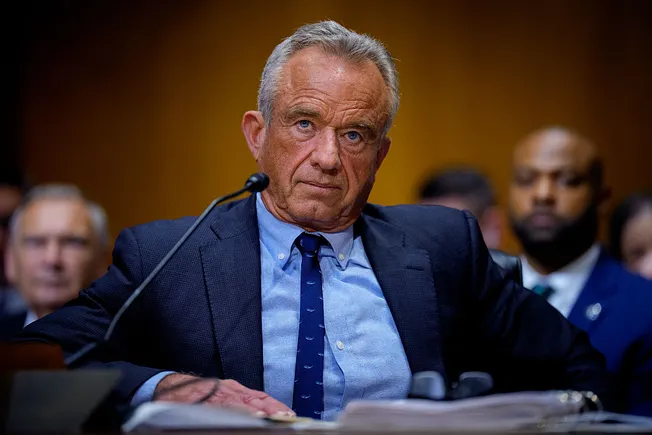
U.S. lawmakers clashed with Health and Human Services Secretary Robert F. Kennedy Jr. over his changes to the country’s vaccine policy and oversight of the Centers for Disease Control and Prevention, including the recent ouster of director Susan Monarez.
Several members of the Senate Finance Committee called for Kennedy’s resignation at a hearing Thursday amid turmoil at the CDC after Monarez was ousted less than a month after taking the job. In an op-ed published Thursday, Monarez said she was fired for refusing to preemptively sign off on recommendations from Kennedy’s hand-picked vaccine advisory panel, which is set to meet next month.
When questioned on Monarez’s firing by Sen. Ron Wyden, D-Ore., the committee’s senior Democrat, Kennedy accused her of lying. “I did not say that to her, and I never had a private meeting with her,” Kennedy said. “Other witnesses to every meeting that we have, and all those witnesses will say, I never said that.”
Monarez’s firing, and subsequent resignation by other senior agency scientists, were cited as evidence of the chaos of Kennedy’s leadership, which has included layoffs of thousands of employees at the CDC, the Food and Drug Administration and the National Institutes of Health. (Hundreds of workers were later reinstated at the CDC and at the NIH.)
Nearly two dozen health advocacy groups released a letter Wednesday calling for Kennedy’s resignation. The departure of senior CDC leaders was the “final exclamation point on a term defined by repeated efforts to undermine science and public health,” they wrote.
There was even criticism by senators from President Donald Trump’s own party, including Bill Cassidy, R-La., who provided the key vote to confirm Kennedy to the role, and Thom Tillis, R-N.C.
“I don’t see how you go over four weeks from a public health expert with unimpeachable scientific credentials, a long time champion of [Make America Healthy Again] values, a caring and compassionate and brilliant microbiologist, and four weeks later, fire her because, at least the public reports say, because she refused to fire people that work for her,” Tillis said.
Senators also criticized Kennedy for replacing previous members of the CDC vaccines committee, citing conflicts of interest. The panel has now “lost scientific credibility,” Wyden said.
Many of the new panelists have either been critical of or lack expertise in vaccines, and heavily questioned the evidence supporting COVID-19 shots during their first meeting in June. The committee also resurrected an old debate around a vaccine preservative that has long been targeted by vaccine skeptics.
Previous members of the CDC’s vaccine advisory panel, known as ACIP, have called for an alternative to the group, while the American Academy of Pediatrics, which is a regular participant in the ACIP process, broke from the agency’s recommendations and released its own childhood vaccination guidelines.
During the hearing, Kennedy claimed AAP is “gravely conflicted.” He has said the group receives money from vaccine makers, although in a prior post to X he referred instead to the group’s associated philanthropy Friends of Children Fund.
Cassidy questioned the new ACIP members’ conflicts of interest, noting some received revenue for serving as witnesses in litigation against vaccine makers. When asked if Kennedy saw this as a conflict of interest, Kennedy said no.
“It may be a bias, and that bias, if disclosed, is OK,” Kennedy said.
A recent study found financial conflicts of interest among ACIP members has been low, with an average of 6.2% since 2016 — far lower than Kennedy’s claim of 97%.
Experts and Senators worry the new panel could rescind vaccine recommendations even further. A meeting scheduled this month is set to feature discussions on vaccines against respiratory syncytial virus, hepatitis B and COVID-19.
“We’re seeing deaths from children from measles — we haven’t seen that in two decades. We’re seeing that under your watch. You are a hazard to the health of the American people. I think that you ought to resign, and if you don’t resign, the President of the United States who put forward Operation Warp Speed, which worked, should fire you,” Sen. Raphael Warnock, D-Ga.
Among other changes to vaccine policy, Kennedy defunded more than $500 million in contracts for research and development on messenger RNA vaccines, the same technology that enabled Pfizer and Moderna to quickly develop safe and effective COVID shots during Operation Warp Speed under Trump’s first term.
Kennedy has regularly claimed mRNA vaccines are not safe or effective, despite many studies proving otherwise. Over the weekend, Trump called on Pfizer and Moderna to make their data public, even though results from dozens of studies testing their shots have been published in medical journals and presented publicly. In statements in response, both companies defended their products. Pfizer went further, saying the success of Trump’s Operation Warp Speed “would typically be worthy of the Nobel Peace Prize, given its significant impact.”
“Is Trump and the medical community right, or are you right?” Sen. Bernie Sanders, D-Vt., asked Kennedy during the hearing.
“You’ve got the entire medical community on one side. You’ve got the [American Medical Association] representing hundreds of thousands of doctors, the American Academy of Pediatrics, the American Public Health Association, all of these organizations are telling us that the COVID vaccine and vaccines in general are safe and effective,” Sanders added. “You are casting doubt on that.”